
The Fall of 'El Mencho': A Strategic Window for Mexico's Mining Expansion
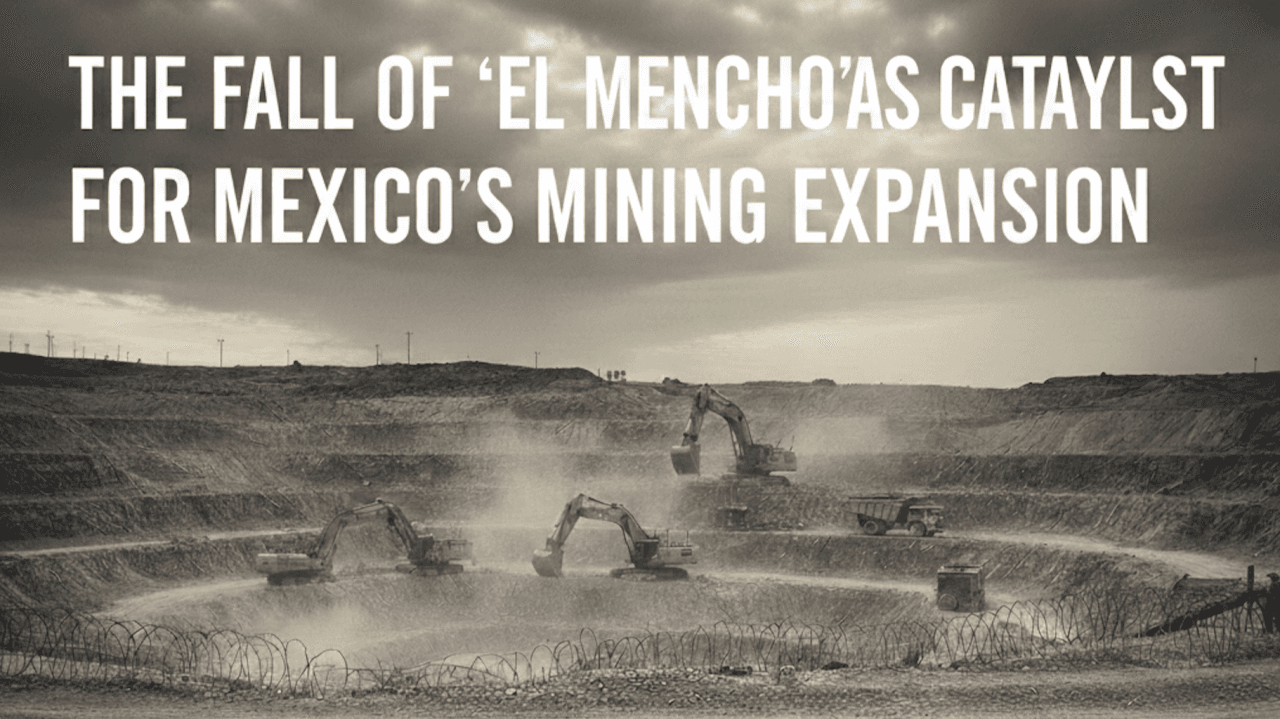
I am writing these lines from New Delhi, India, where I am attending the Annual Conference of the Inter-Pacific Bar Association (IPBA) — three days of sessions on the future of law, in a forum where the world's most influential legal minds converge. The news that has dominated every country-risk conversation here is the fall of the leader of the Jalisco New Generation Cartel (CJNG), killed by the Mexican Army on 22 February 2026 in Tapalpa, Jalisco.
Mexico is a world-class mining jurisdiction. Any shift in its internal order resonates immediately in Toronto, New York and London — the three capitals where Mexican mining equity is priced.
This event is not merely a tactical police success. For an industry whose assets are geographically immovable, the end of a hegemonic criminal leadership is a strategic window: an invitation to evolve from a "crisis management" model toward one of disciplined growth, grounded in the most rigorous international legal standards.
1. A view from New Delhi: why a cartel leader moves mining country risk
Mining cannot relocate. A pit, a heap-leach pad, a concentration plant and a tailings dam are fixed where the ore is. When security deteriorates around a mine, the company does not move the asset — it absorbs the cost: longer routes, private security, suspended shipments, higher insurance, delayed permits.
That is why the death of Nemesio Oseguera Cervantes, "El Mencho", was the first item in every risk briefing I heard that week. It was also why the immediate aftermath mattered: the operation triggered a wave of retaliatory roadblocks — authorities counted some 85 blockades across more than a dozen states, and unrest was reported in at least 22 states in the following days — before relative calm returned with the deployment of the Army and the National Guard.
Six months later, the picture is more nuanced, and it is worth stating plainly for investors:
- The State maintained an offensive against the CJNG, with the arrest of mid- and senior-level operatives and the near-capture of others.
- Succession remains unresolved; the presumed heir is widely reported but unconfirmed, and analysts describe a structure that is "crouched, watchful".
- Security firms describe the risk profile as shifting from centralized cartel dominance to decentralized instability: higher short-term volatility, medium-term risk depending on whether the organization consolidates or fractures.
For a mining board, the lesson is not "Mexico is now safer". It is that the nature of the risk changed, and that risk models built around a single, predictable counterpart at the top are now obsolete.
2. The constitutional imperative: rule of law as investment infrastructure
To unlock Mexico's mining potential, we must candidly address the legal and policy failures of the past. The doctrine of "abrazos, no balazos" ("hugs, not bullets") was founded on conflict avoidance, but in practice it eroded the rule of law by allowing criminal organizations to institutionalize extortion as a de facto operating tax. A culture of legal shortcuts — the attitude that "the law is whatever we say it is" — is the germ of the impunity companies now price into every contract.
The opportunity lies in re-professionalizing the security apparatus. The Constitution charges the Executive with deploying the armed forces to preserve internal order and defend sovereignty. In recent years, those forces have absorbed civilian and commercial assignments alongside that core mandate. Returning them to the primary mission — securing national territory and strategic corridors — provides the "hard security" layer that allows corporate compliance to flourish.
The economics are not abstract. The Mexican Mining Chamber has reported that 97% of mining companies have suffered some type of crime, most often petty theft and extortion, concentrated in Durango, Zacatecas and Guanajuato. Industry risk studies estimate that extortion and protection rackets add roughly 3% to production costs, on top of dedicated security budgets. A secure territory is the fundamental prerequisite for exponential investment; everything else — compliance programs, ESG reporting, offtake contracts — is built on top of it.
3. The 2026 USMCA review: from a one-off renewal to annual leverage
The joint review of the USMCA (T-MEC) was scheduled for 1 July 2026 under Article 34.7 of the Agreement. It became the perfect legal framework to reposition Mexico's mining sector — but not in the way most commentators expected.
On 1 July 2026 the three Parties met, and the United States declined to renew the Agreement in its current form. The consequence is precise and widely misread: the USMCA did not terminate. It remains fully in force, but it now enters a cycle of annual reviews until its scheduled expiry on 1 July 2036, unless the Parties confirm a sixteen-year extension at any point in between. Mexico and Canada both backed the extension; the negotiation is now bilateral, with rounds held in Mexico City (May), Washington (June) and Mexico City again in July, focused on rules of origin, economic security and — critically for this sector — critical minerals.
Three implications for mining:
- Nearshoring still needs Mexican minerals. As North America de-risks its supply chains, Mexican silver, gold, copper and zinc are the crown jewels of regional energy and industrial independence. A fragmented, annually-renegotiated trade regime rewards partners who can offer documented reliability.
- Compliance is now a trade requirement, not a courtesy. The treaty's labor and environmental chapters already bite. In June 2026 the United States invoked the Rapid Response Labor Mechanism against Newmont's Peñasquito operation in Zacatecas following a union petition; by August the Mexican labour authority had confirmed violations and both governments were implementing a remediation plan. Whether one agrees with the complaint or not, the mechanism demonstrates the point: a mining asset in Mexico can now be partially suspended from the US market for a compliance failure. Contractual, labor and integrity systems are part of the tariff-equation.
- Annual reviews create recurring decision points. Every July becomes a moment where country risk is reassessed by trade negotiators, insurers and index providers. Companies that can show verified supply-chain integrity — beneficial ownership, third-party diligence, clean payment flows — convert that scrutiny into a competitive advantage.
4. Geography of conflict: strategic assets and foreign capital
The leadership vacuum generated by the fall of "El Mencho" impacts key zones where companies operate under transnational legal frameworks such as the U.S. Foreign Corrupt Practices Act (FCPA), the Canadian Corruption of Foreign Public Officials Act (CFPOA) and the OFAC sanctions program.
| Zone | Asset and capital | What the record shows | The opportunity |
|---|---|---|---|
| Zacatecas — the Silver Corridor | Peñasquito (Newmont, U.S. capital), in Mazapil | Roughly one-third of Mexico's mine production comes from Zacatecas; the asset is also now subject to a USMCA labor review | Secure logistics plus a remediated labor file: the template for a Tier-1 asset |
| Guerrero — the Gold Belt | Los Filos and El Limón-Guajes (Equinox Gold, Canadian capital) | Heap-leach operations were suspended through 2025 and the first half of 2026 after a community land-access agreement expired; twenty-year agreements with all three host communities signed in June 2026 opened the restart | From extorted logistics to negotiated, contractual corridors that protect shareholder value and employee integrity |
| Jalisco — the industrial heart | San Martín (First Majestic Silver, Canadian capital) | Placed under care and maintenance in July 2019 precisely because of insecurity; agreement to sell the asset announced in July 2026 for US$90 million, pending antitrust clearance | The clearest case study: insecurity turned a producing asset into a sale. Jalisco can pilot Reinforced Due Diligence and Ultimate Beneficial Owner (UBO) protocols |
| Sinaloa — the northwestern flashpoint | Multiple operators, incl. Canadian silver explorers | Ten workers were abducted from a mining operation in January 2026; nine were later confirmed dead. Unrest remained concentrated in states representing roughly 1.5% of national output | Contains reputational contagion while protecting operating licenses |
| Chihuahua and the north | Roughly 12% of national production | Distance from the epicentre, but exposed to route risk and cross-border flow control | Nearshoring-facing operations with the strongest compliance premium |
The pattern is consistent: where governance is weakest, the discount is largest; where compliance is strongest, the premium is highest. Foreign capital does not avoid Mexico — it avoids unverifiable counterparty chains. Investors who establish operations with foreign investment and paper their relationships in commercial contracts drafted for this environment do not eliminate the risk; they price it, allocate it and document it.
5. Technical analysis: "willful blindness" and the sanctions trap
Under international law, deliberate ignorance — "willful blindness" — is not a defense. It is a way of establishing the very knowledge element the defense claims was missing.
- FTO and SDGT designations. In February 2025 the U.S. State Department designated eight Latin American criminal groups — including the CJNG and the Sinaloa Cartel — as Foreign Terrorist Organizations and Specially Designated Global Terrorists; the list has continued to grow through 2026. Under 18 U.S.C. § 2339B, knowingly providing "material support or resources" — broadly defined to include currency, services, lodging and transportation — is a federal crime, and courts will infer knowledge where a company consciously avoided obvious facts.
- The OFAC trap. Civil sanctions liability is strict: a transaction with a blocked person can be penalized even without intent or knowledge, and the 50 Percent Rule blocks any entity owned half or more, directly or indirectly, by blocked persons — entities that appear on no list at all. The realistic exposure is not a symbolic delisting: it is the blocking of assets within U.S. jurisdiction, secondary-sanctions risk for non-U.S. persons, loss of correspondent banking, and — for listed issuers — the very real threat of exchange removal.
- The FCPA, reloaded. After an early-2025 pause, the Department of Justice resumed FCPA enforcement with an explicit priority: cases involving cartels and transnational criminal organizations. In July 2026 a U.S. supply-chain company entered a deferred prosecution agreement, paying nearly US$9.8 million over bribes routed through customs brokers — payments that, without its knowledge, benefited persons associated with a cartel operating at the border. The company's ignorance of the cartel connection did not shield it. As the U.S. Attorney for the Western District of Texas put it, nothing crosses the border without payment to cartels, and businesses engaged in cross-border trade bear responsibility for not benefiting from them.
The practical translation for a mining operator: if your haulier, your camp caterer, your "route security" provider or your customs broker is controlled by a designated group, you may be one payment away from a criminal theory you never imagined.
6. Mexican law: Article 421 of the CNPP and "due control"
Mexico has its own hook. Article 421 of the National Code of Criminal Procedures establishes that legal entities are criminally liable for offences committed in their name, for their account or benefit — when it is additionally determined that there was a "failure to exercise due control in the organization" (inobservancia del debido control en su organización).
Two consequences follow. First, a compliance manual in a drawer is insufficient: the test is whether the control operated. Second, the sanction scales with the magnitude of that failure and with the company's degree of legal compliance — which means an active, documented program is both prevention and mitigation.
A compliant framework in this environment requires, at minimum:
- Third-party due diligence through the full chain — carriers, subcontractors, lessors, security providers, fuel suppliers — not only the tier-one counterparty;
- Beneficial-ownership verification against the 50 Percent Rule and local corporate records;
- Route and municipal risk mapping, overlaid with the specific geography of each designated group;
- A written protocol for payments under coercion, with mandatory escalation to legal and compliance before anyone pays a "right of way" fee;
- Documented escalation and investigation — in an investigation, proving that you acted in good faith with reasonable controls is the best answer to a willful-blindness allegation.
Notice the evidentiary dimension. The facts you may need two years from now — the state of a route, the condition of a facility, who actually operates a yard — are far cheaper to fix in advance. A certificate of facts drawn up by a public broker converts an observation into a public instrument with a certain date, which is exactly what a prosecutor, a regulator or an arbitral tribunal will ask you to produce.
7. The operational dilemma
Imagine your primary transporter is coopted by a new cell following the cartel's fragmentation. Stopping operations costs millions per day. Paying the extortion guarantees "operational peace" — and, potentially, an international criminal proceeding for your board.
What decision would you make today?
- Do you blindly trust your local providers?
- Do you have immediate dissociation and escalation protocols?
- Does your board understand that, legally, willful blindness is corporate suicide?
8. Frequently asked questions
Does paying extortion protect a company from prosecution?
No. Extortion may support a duress argument in narrow circumstances, but recurring payments, mislabeled as "consulting" or "route fees", are exactly what prosecutors recharacterize as knowing support. Payments under coercion must be recorded accurately and escalated.
Does the FCPA apply to a non-U.S. company with Mexican operations?
It can. Jurisdiction arises through U.S. dollar clearing, U.S. banks, U.S. persons, U.S. insurers or financing, or any listing in the United States. Canadian issuers face the parallel CFPOA, and anyone in the chain may face OFAC exposure regardless of nationality.
What exactly is "willful blindness"?
It is the judicial doctrine by which knowledge is inferred from a conscious decision to avoid confirming an obvious fact — a suspicious counterparty, an unexplained fee, an owner hidden behind nominees. It closes the gap between "I did not know" and "I did not want to know".
Does the USMCA protect mining investors against security failures?
Only partially. Chapter 14 preserves a narrow investor-state route: Annex 14-D covers most U.S.–Mexico investments (excluding establishment), and Annex 14-E preserves broader protection for certain covered government contracts — including major infrastructure — while Canada sits outside the framework. Whether cartel extortion can breach the full-protection-and-security standard is being tested in practice; the prudent investor assumes the treaty is a backstop, not an insurance policy. Alongside it, commercial mediation and arbitration clauses remain the fastest route to resolve supplier, contractor and community disputes before they escalate into a state claim.
What is the single most effective first step?
Verify the beneficial owner of your logistics chain — this morning. Ownership behind a transport or security contractor is the variable that determines whether a routine payment is commerce or material support.
Conclusion
The news of "El Mencho's" fall, travelling through New Delhi, was a wake-up call. The era of informal arrangements is not over because Mexico became safe; it is over because the legal consequences of those arrangements became severe and simultaneous — FCPA and material-support theories, strict sanctions liability, USMCA labor mechanisms and Mexican corporate criminal liability, all converging on the same payment.
By combining a security apparatus that secures the land with a legal and compliance class that secures the transactions, Mexico can invite the world to invest not just in its minerals, but in its legal certainty. The policy of "hugs" has failed. The policy of the law — applied, documented and enforced — is the competitive advantage now on offer.
Capital does not seek resources alone. It seeks rules of the game it can verify.
Let's talk
We can review your counterparty chain, map route and beneficial-ownership risk, and put in place the escalation protocol your board will be asked about when — not if — the question arrives.
To start the conversation, write to me from the contact page.
Related services
Related articles
- Compliance Under Fire: The Vizsla Silver Tragedy and the False Humanitarian Dilemma
Ten miners, ten deaths, two incompatible stories: why paying extortion is never mercy but criminal exposure under the FCPA, OFAC and the CFPOA.
- Doing Business in Mexico? Discover the Key Role of the Corredor Público
What a Corredor Público does for foreign investors in Mexico: incorporation, shareholder minutes, valuations and arbitration — faster and at lower fees than a notary.